
Watt’s Lifestyle framework helps you visualize how you live: the way your time is distributed across sleep, duties, and life. By connecting to your devices and calendars, Watt reveals the structure behind your days and the patterns that shape your focus, balance, and vitality.
Across history, civilizations have always understood that time is life. From early calendars and sundials to monastic schedules, seasonal rhythms, and modern work structures, societies have tried to make sense of how human time should be lived. Every individual who achieved lasting success — thinkers, builders, leaders, and creators — did so by learning how to manage their time, energy, and responsibilities with discipline and balance.
Today, technology has fragmented our time and attention, preventing us from focusing on what matters to us. Watt puts your behavioral data in your control to help you structure, organize, and plan your time and shape your ideal lifestyle.
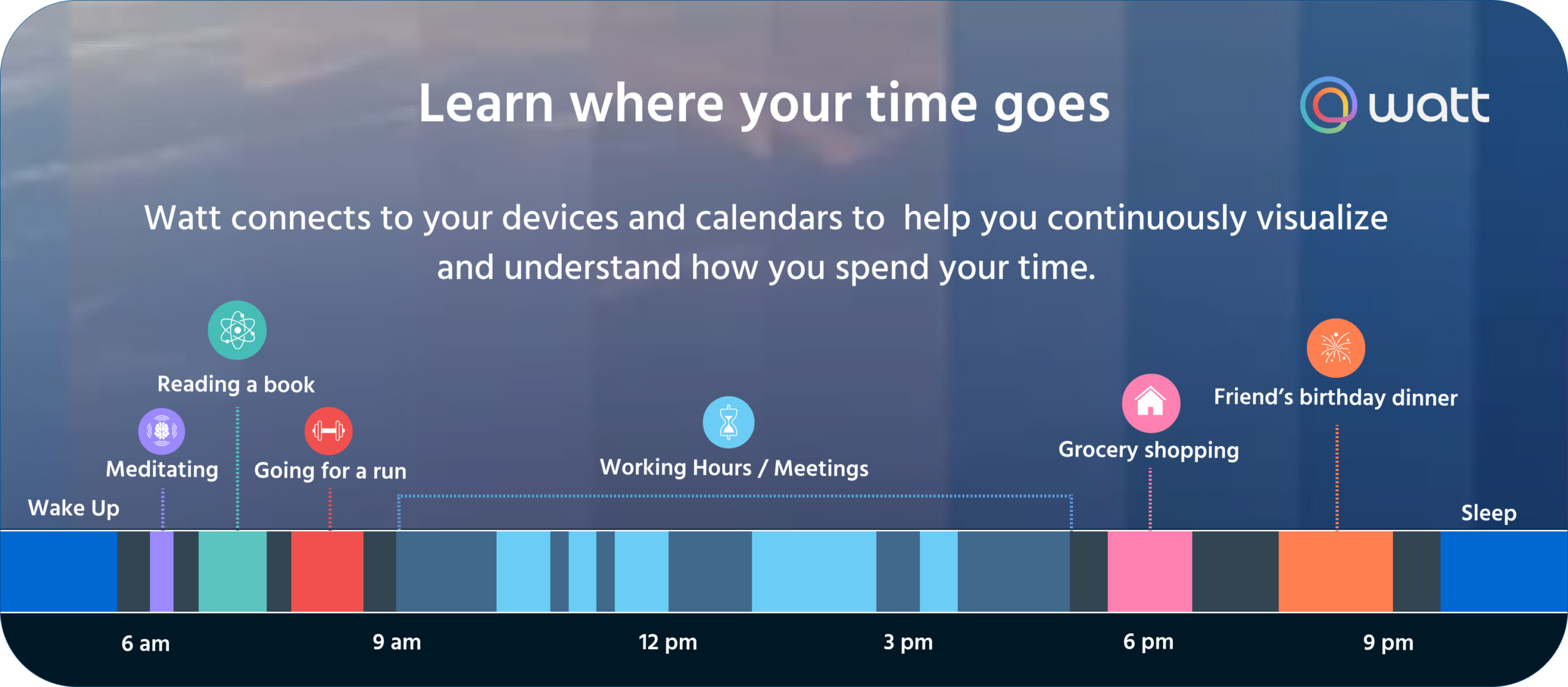
Watt connects to your devices and calendars to help you organize and categorize your time spending. Watt’s Lifestyle categories are inspired in global time-use surveys, used by governments to understand how populations allocate time and to inform public health, labor policy, and social planning. Watt applies the same principles at the individual level, giving you a comprehensive, seamless and research-backed way to understand your own life as a system rather than a collection of tasks.
In Watt, every lifestyle category has an assigned color –customizable to fit how you view life– to help you more easily understand how you are investing your time.
These categories are:
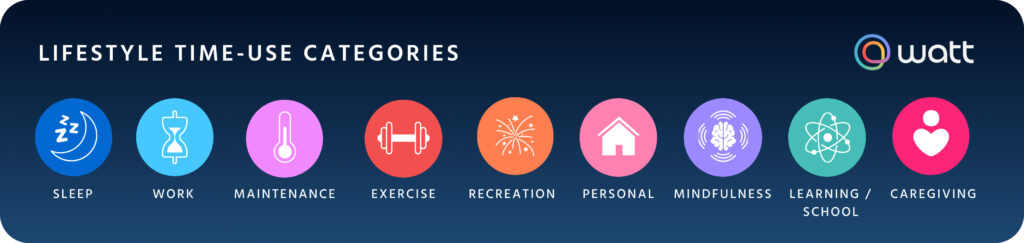
Watt organizes your time around three fundamental pillars that define how every life is lived: Sleep, Duty, and Life. Together, they account for all intentional and restorative time across a day. By understanding how much waking time is spent executing duties versus living, and how sleep supports both, Watt can measure Busyness and reveal whether your lifestyle is balancing duty and life:
Sleep represents the time dedicated to biological recovery. It defines the baseline capacity for every waking decision that follows. Without understanding sleep, lifestyle analysis remains incomplete.
Sleep Signals: Smartwatches, fitness trackers and Lifelog Check-ins.
Duties include the activities that sustain your life and commitments, such as Work, Caregiving, Personal Maintenance or School. They provide structure, responsibility, and contribution. Duties are necessary and meaningful, but they also consume energy. Left unmanaged, duties tend to expand and dominate available time, gradually reducing balance and recovery.
Duty Signals: Work Calendars, Duty Cycle Schedules, and Check-ins.
Life includes personal time, exercise, recreation, learning, and mindfulness.
What restores us is not leisure alone, but how we give meaning to leisure. Passive rest may reduce fatigue temporarily, but meaningful life activities support long-term vitality, emotional resilience, and motivation.
Watt treats life as an active contributor to balance, not as leftover time.
Life Signals: Personal Calendars, Smartwatches, GPS Location, Wellness Apps, Life Activities Cycles, and Lifelog Check-ins.
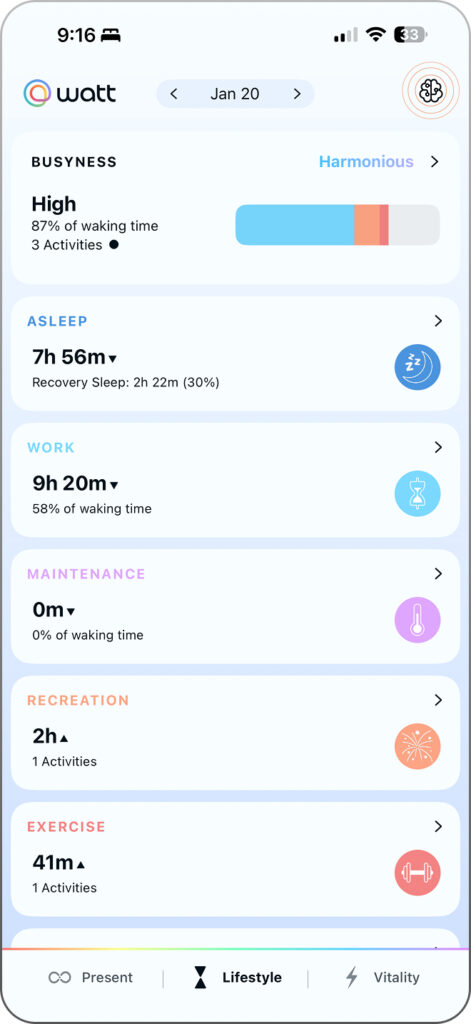
Busyness is Watt’s main lifestyle metric. It represents the percentage of waking time spent executing intentional activities. Busyness helps you learn how much of your time has been spent intentionally with a purpose, and how much free discretionary time you have available. Tracking your busyness can give you a clear overview of how much time your duties are demanding and how well you are investing your leisure time in life-enhancing activities.
Duty–Life Balance is calculated using Busyness as the foundation. It reflects how your intentional waking time is distributed between duties and life activities.
Everyone has a different rhythm that works for them. Some periods of life demand more duty, focus, and responsibility. Others allow for more space, flexibility, and recovery. What matters is not enforcing a fixed ratio, but ensuring that whatever time you have available supports your energy and sense of meaning. When duty is high, balance comes from using limited free time intentionally in life-enhancing activities that restore, move, and engage you. When leisure is abundant, balance comes from giving part of that time structure, purpose, and direction. Watt helps you understand whether your lifestyle rhythm is supporting you or slowly working against you, so balance becomes personal, not prescriptive.
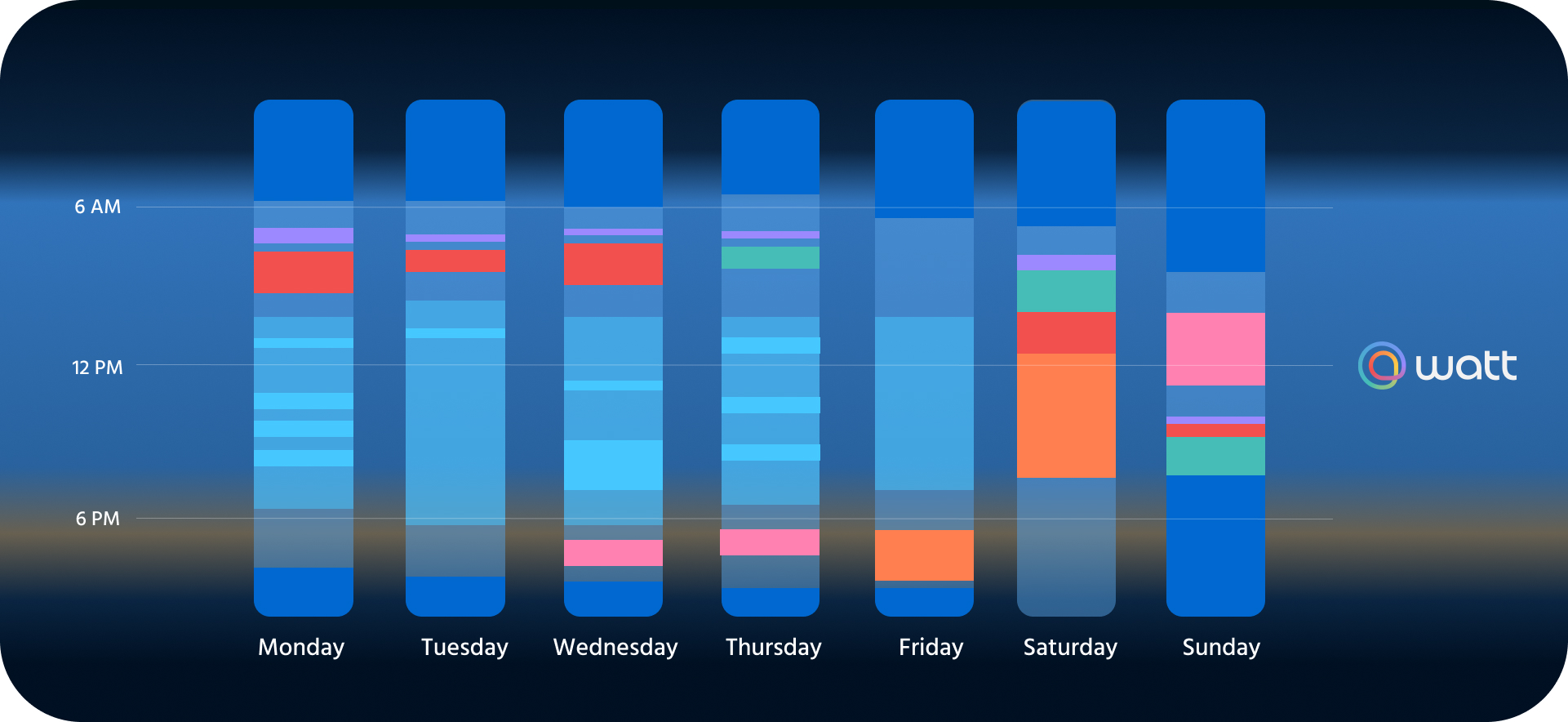
Duty–Life Balance is best understood across weekly patterns, not isolated days. Watt classifies each day into one of five balance states:
Harmonious: Duty and life are evenly distributed. Days like this reinforce stability, recovery, and sustained energy.
Duty+: Duty slightly outweighs life. These days strengthen discipline and progress when followed by recovery-oriented days.
Life+: Life slightly outweighs duty. These days promote mental clarity and restoration when alternated with focused effort.
Duty++: Duty strongly dominates the day, leaving little room for recovery. Useful in short bursts, but unsustainable if repeated.
Life++: Life strongly outweighs duty, with minimal structured effort. Helpful for restoring depleted energy, but destabilizing if prolonged.
Research in psychology and behavioral science consistently shows that people who feel aware of and in control of their time experience lower stress, higher life satisfaction, and greater resilience over time. These effects are not driven by working less or having more resources, but by clarity over how time is actually spent.
When time is invisible, decisions are reactive. When time is visible, decisions become intentional. By being aware of how you spend your time you gain a broader visibility of your life, which empowers you to make better daily decisions.
Watt helps you manage your time by visualizing where it goes and building your ideal lifestyle. By briefly logging activities and automatically capturing signals from calendars, wearables, and devices, Watt builds a continuous picture of how your life unfolds with minimal effort.
Over time, this leads to:
Clearer priorities and better decisions
Reduced stress and mental load
Earlier detection of imbalance and burnout
Greater sense of control over your time and energy
Watt’s goal is to automate lifestyle tracking as much as possible, so awareness comes from living, not constant input. The result is a system that works quietly in the background, helping you use your time in your favor.
How Watt protects your data: Watt is designed with privacy as a foundation. Your behavioral and physiological data is handled using security and privacy practices aligned with HIPAA and GDPR guidelines, meaning it is stored securely, accessed only to provide insights, and treated with the same care expected in regulated health and data environments.