
Watt’s Vitality Score represents your overall energy levels: the balance between recovery and activity that allows you to perform, think, and feel at your best. The higher your Vitality score, the healthier and more sustainable your lifestyle truly is.
Across cultures and throughout history, Vitality has appeared again and again under different names. In Eastern traditions it was described as qi or prana. In Western philosophy, as vital force or pneuma. Each culture was attempting to describe the same phenomenon: a person’s life force, their capacity to engage with life, adapt to stress, and recover over time. By using your modern wearable device, Watt can now help you observe and measure what those traditions intuitively understood. Health is the absence of illness, but Vitality is the presence of energy.
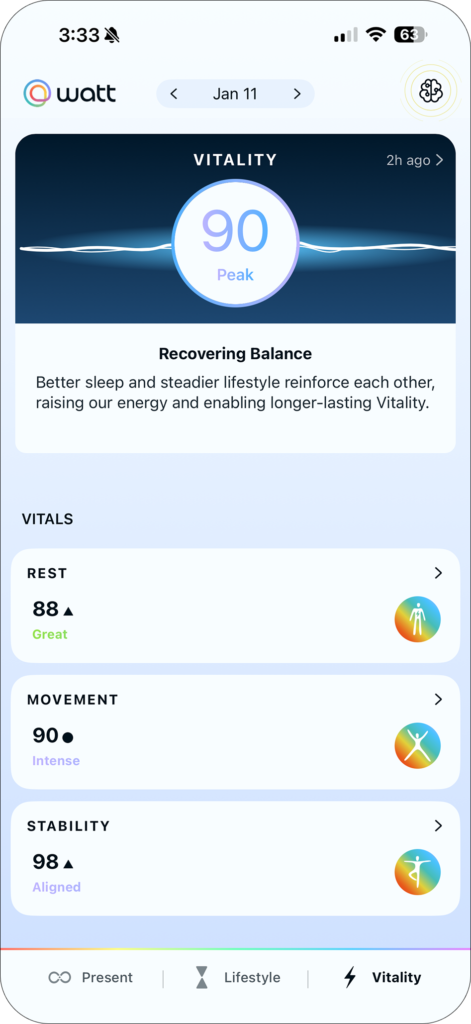
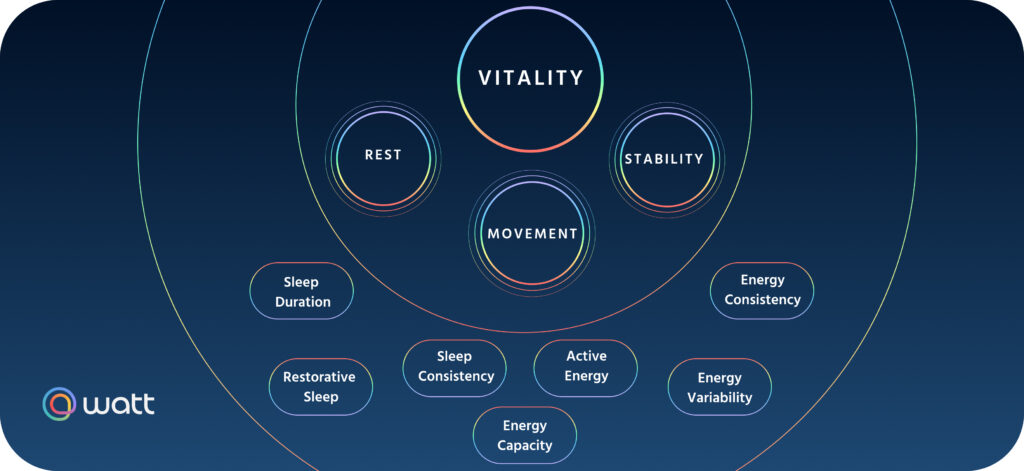
Vitality is measured using the sleep and energy expenditure data from your smartwatch or fitness wearable. The Vitality Score is calculated by analyzing more than 10 physiological and behavioral metrics that research consistently links to longevity and life satisfaction. Every day, after wake-up is detected, Watt calculates your Vitality based on three core pillars of energy regulation:
When you sleep well, move consistently, and maintain stable daily rhythms, your body operates efficiently. Recovery improves, focus sharpens, and resistance to illness increases. When one of these elements breaks down, energy slowly declines, often before symptoms are noticeable. Your Vitality Score connects these elements into a single, coherent signal that helps you learn how your lifestyle is impacting your energy levels.
Watt’s Vitality Score is expressed on a 1 to 99 scale and uses data from your last 7 days of sleep and energy expenditure. The Score and is designed to help you understand your energy levels easily but also allows you to go deeper into your metrics if you wish to learn more about what’s driving it. Rather than labeling energy as simply “high” or “low”, the scale reflects degrees of capacity, resilience, and balance across time.
In Watt, a Vitality score above 70 generally indicates a lifestyle pattern that aligns with established research on healthy sleep, physical activity, and routine consistency.
Vitality is calculated from three pillars: Rest, Movement, and Stability — each of which is:
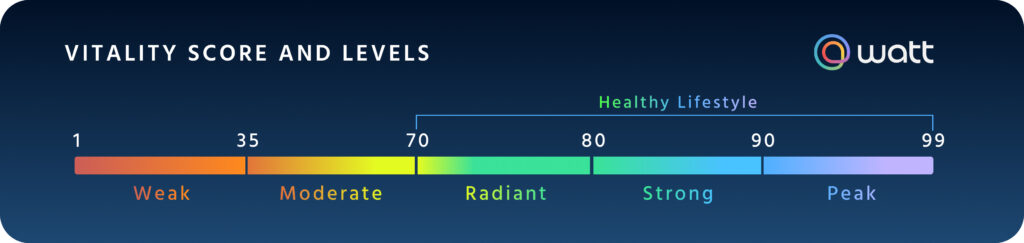
Watt translates the Vitality score into clear levels to support interpretation. These levels help you understand not just where you are, but how much capacity you have to take on additional demands:
Vitality is shaped by three science-backed metrics: Rest, Movement, and Stability. These metrics are calculated from behavioral and physiological submetrics. Together, they reflect recovery, activity, and rhythm over time.
Rest is the foundation of Vitality. Without adequate recovery, nothing else works. The Rest Score evaluates sleep duration, sleep quality, heart rate, and energy expenditure to estimate how much energy your body has available.
Low rest signals accumulated fatigue. High rest signals readiness and resilience. Understanding rest allows you to manage your time realistically instead of pushing against biological limits.
Rest Submetrics: Sleep Duration, Deep Sleep (SWS), REM Sleep, and Sleep Consistency.
Movement reflects how physically active your lifestyle is relative to your body. Watt measures daily energy expenditure in relation to body weight and compares it to established health standards such as the World Health Organization’s Physical Activity Guidelines.
By Tracking your Movement Score you can quickly detect whether your activity levels support mental and physical health. Movement is not about intensity alone. It is about consistency and sufficiency over time.
Movement Submetrics: Active Energy, Resting Metabolic Rate (RMR), Height, Weight, Age and Gender.
Stability reflects circadian health and lifestyle regularity. The Stability Score analyzes variation in sleep timing, wake timing, and daily energy patterns. Even with sufficient sleep and exercise, irregular schedules disrupt circadian rhythms and gradually reduce Vitality.
Stability allows rest and movement to compound instead of canceling each other out.
Stability Submetrics: Sleep Consistency, Active Energy Consistency (weekly), and Active Energy Variability (daily).
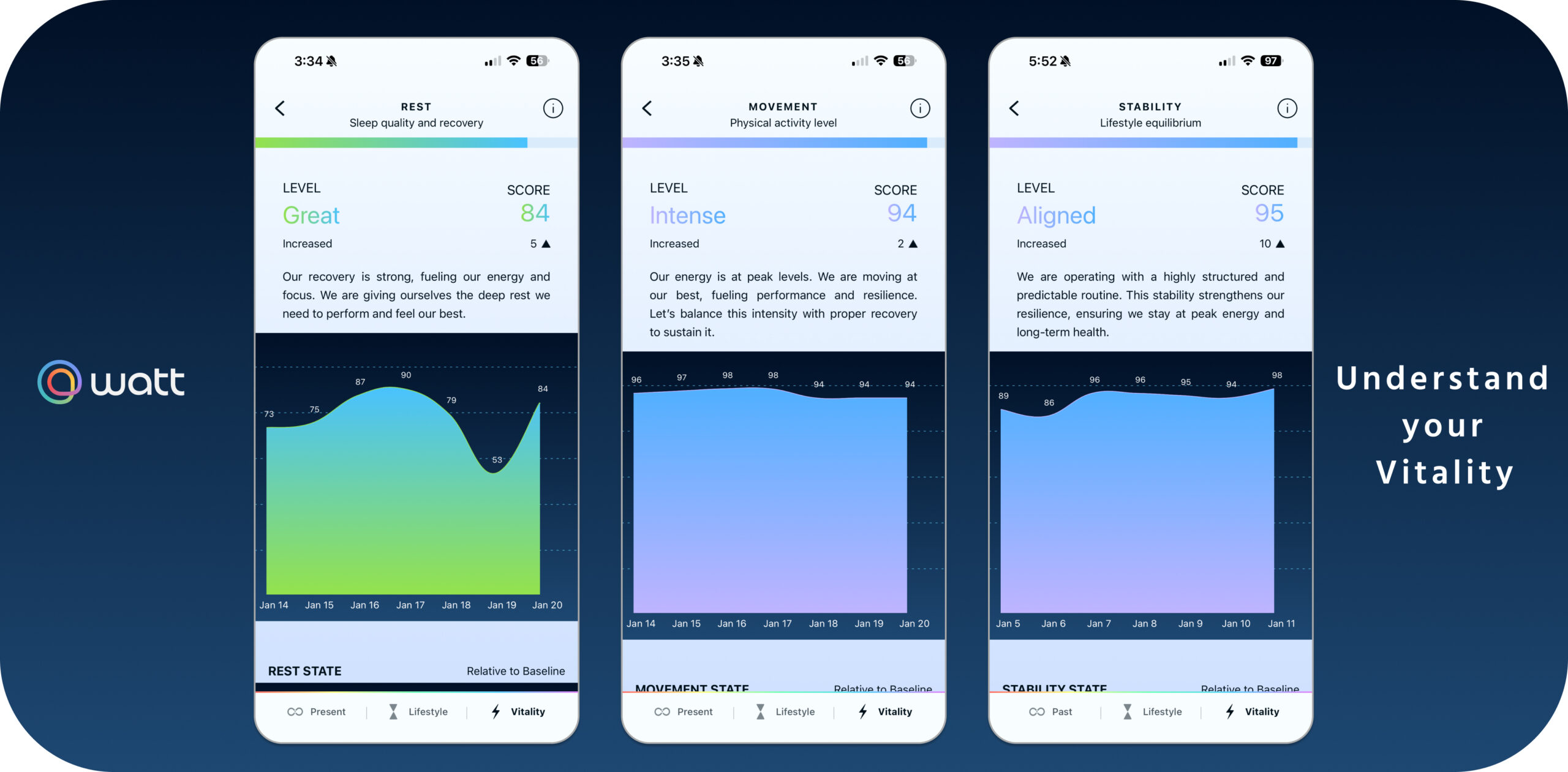
Vitality reflects how well your body transforms rest, movement, and stability into sustained energy. Decades of psychophysiological research show that when these pillars are aligned, people perform better, recover faster, and remain healthier for longer.
Your Vitality score teaches you to live in a way your body can sustain. It gives you a continuous mirror of how your lifestyle is affecting your energy levels. Combine your Vitality Score with your Busyness and Duty-Life Balance, to make meaninful changes to your habits. The most effective way to increase Vitality is not through drastic changes, but through:
Vitality takes time to build and little effort to lose. Tracking it helps you recognize early signals, adjust your lifestyle proactively, and protect your long-term energy.
DISCLAIMER: Watt Labs’ Vitality Score is an informational metric designed to support self-awareness, not a medical evaluation. The Vitality Score does not diagnose, treat, or prevent disease and should not be used as a substitute for medical advice.